










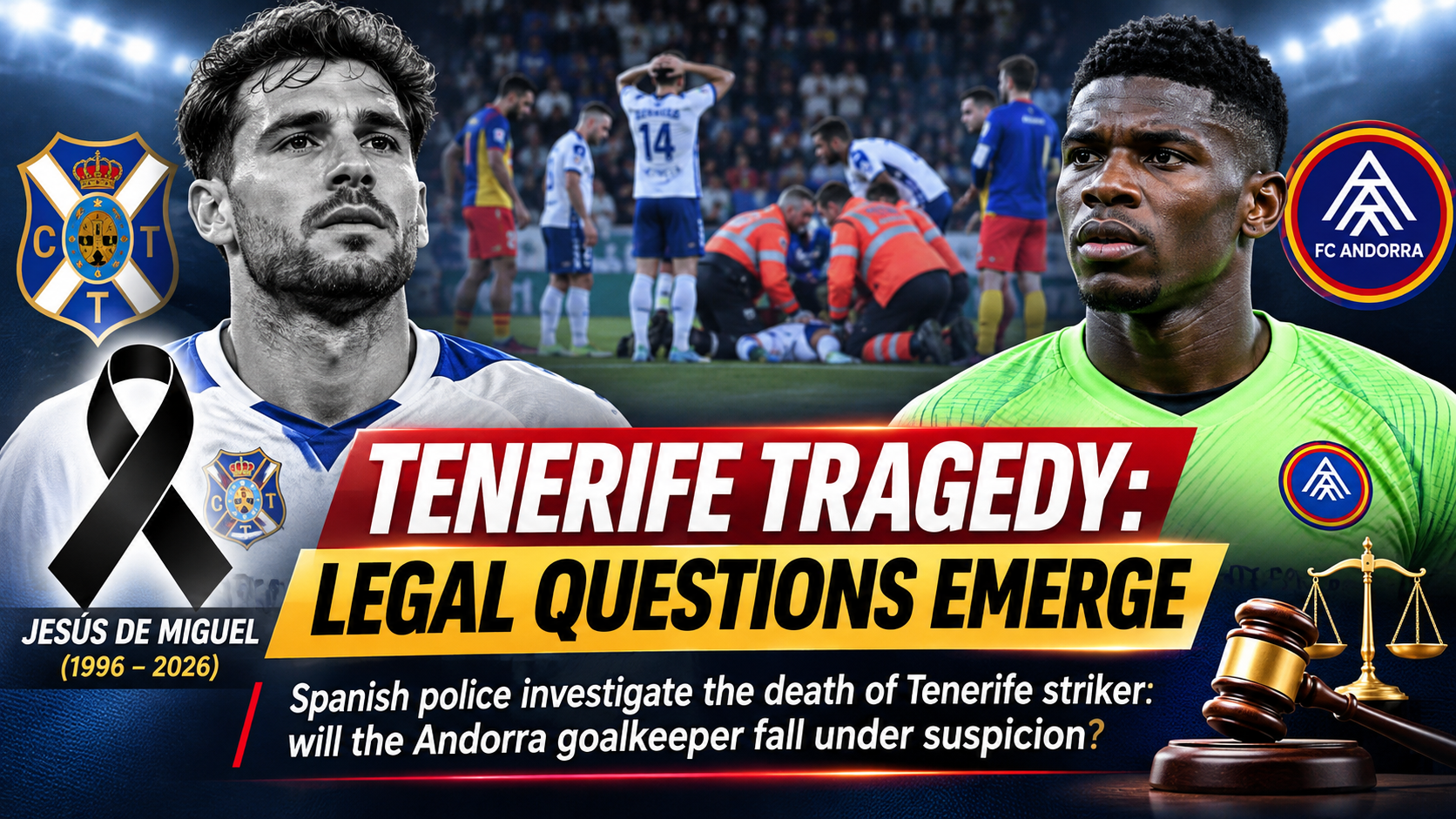
Spanish football has been shaken by the tragic death of CD Tenerife striker Jesús de Miguel following a serious collision with FC Andorra goalkeeper Jesús Owono. The incident, which occurred during a Segunda División match on November 2, 2026, has raised difficult questions about player safety, sporting responsibility, and whether an on-field challenge could lead to criminal proceedings.
The 30-year-old Tenerife forward died on Tuesday, November 3, after receiving emergency medical treatment following the collision. His death has prompted widespread mourning across Spanish football, while attention has turned toward the circumstances of the goalkeeper’s challenge.
Although Owono received a straight red card, the possibility of criminal responsibility remains a separate legal question. No confirmed criminal charge against the goalkeeper has been established in the reporting reviewed.
What Happened During Tenerife vs FC Andorra?
The tragedy unfolded during the closing stages of Tenerife’s home match against FC Andorra at the Estadio Heliodoro Rodríguez López.
With the match level at 2-2, Andorra goalkeeper Jesús Owono rushed out of his penalty area toward midfield to challenge for a long ball.
Tenerife striker Jesús de Miguel was also attempting to reach the ball when the two players collided. Television footage showed the goalkeeper’s knee making contact with the forward’s chest.
De Miguel initially reacted to the impact before collapsing on the pitch, prompting immediate concern among teammates, opponents, and match officials.
The referee showed Owono a straight red card for the challenge, while medical personnel rushed onto the field to assist the injured striker.
The match was subsequently abandoned as the seriousness of the situation became apparent.

Tenerife Confirms the Death of Jesús de Miguel
A Tragic Announcement Shakes Spanish Football
Following emergency treatment at the stadium, De Miguel was transported to Hospital Universitario de Nuestra Señora de Candelaria in Santa Cruz de Tenerife.
Initial medical updates indicated that he was in serious condition. However, his health subsequently deteriorated.
On November 3, CD Tenerife officially confirmed that the striker had died at 8:00 a.m. local time.
The announcement devastated the football community, with messages of sympathy arriving from clubs, players, supporters, and football organizations.
FC Andorra also expressed its condolences to the player’s family and teammates.
The Spanish football federation responded by postponing several domestic cup fixtures, reflecting the widespread impact of the tragedy.
For supporters in Cambodia and around the world, the incident serves as a painful reminder that footballers face physical risks even during ordinary moments of competition.
Could Andorra Goalkeeper Jesús Owono Face Criminal Charges?
Understanding the Difference Between a Red Card and Criminal Responsibility
One of the central questions surrounding the Tenerife striker death investigation is whether goalkeeper Jesús Owono could face legal consequences.
The goalkeeper’s dismissal was a disciplinary decision made under football’s rules. However, a red card does not automatically establish criminal wrongdoing.
Spanish criminal law recognizes circumstances in which a death caused by serious negligence may lead to criminal responsibility.
Article 142 of Spain’s Penal Code provides penalties for negligent homicide, including imprisonment of one to four years where gross negligence is legally established.
Nevertheless, this provision does not mean that Owono has committed a crime or that criminal proceedings will necessarily follow.
Any legal assessment would need to determine whether his actions went beyond the risks ordinarily associated with competitive football.
What Would Investigators Need to Establish?
If the incident becomes the subject of a formal criminal investigation, several important questions would require examination.
1. The nature of the challenge
Authorities would need to assess the goalkeeper’s movement, the position of the ball, and whether the challenge involved an unreasonable level of risk.
2. Medical evidence
Medical specialists would need to establish the cause of De Miguel’s death and examine the relationship between the collision and his fatal injuries.
3. Video footage and match reports
Television recordings, referee documentation, and potential witness testimony could help reconstruct the incident.
4. The goalkeeper’s conduct
A legal examination would need to distinguish between an unfortunate sporting accident, a reckless challenge, and conduct meeting the legal threshold for criminal negligence.
These questions cannot be answered solely by reviewing the red card or considering the tragic outcome.

Spanish Football Faces Renewed Questions About Player Safety
Can Dangerous Collisions Be Prevented?
The death of Jesús de Miguel has renewed discussion about how football authorities protect players during high-speed challenges.
Modern football involves intense physical competition, with goalkeepers frequently leaving their penalty areas to intercept attacking opportunities.
These situations can create dangerous collisions, particularly when two players approach the ball from different directions.
While football’s disciplinary rules address excessive force and dangerous play, serious injuries can still occur.
The Tenerife incident highlights the importance of emergency medical preparedness, rapid intervention, and consistent enforcement of player-safety regulations.
Football authorities may also face renewed pressure to examine how dangerous challenges are assessed and whether existing safety measures offer sufficient protection.
Why Medical Response Matters
Immediate medical assistance is particularly important when a player collapses following a collision.
Rapid assessment, access to emergency equipment, and coordinated medical intervention can be crucial in life-threatening situations.
The response to De Miguel’s collapse demonstrated the importance of having medical professionals available during competitive matches.
However, the eventual outcome also illustrates the limitations of emergency intervention when an injury is exceptionally severe.
Football Community Mourns Jesús de Miguel
The tragedy has affected far more than the two clubs involved.
Players, coaches, and supporters across Spain have expressed their sorrow following the striker’s death.
De Miguel had built his career through several Spanish clubs before joining Tenerife in 2025.
His football journey reflected the dedication required to establish a professional career in Spain’s competitive league system.
For his teammates and supporters, he will be remembered for his contribution on the pitch rather than the circumstances of his final appearance.
The emotional impact has also extended to FC Andorra, whose players witnessed the incident firsthand.
The club’s public expression of sympathy emphasized the shared grief experienced across the football community.

What Happens Next in the Tenerife Striker Death Case?
Sporting and Legal Questions Remain Separate
Following the tragedy, attention may turn toward any further disciplinary assessment of Owono’s challenge.
Football authorities can review the referee’s report and determine whether additional sporting sanctions are appropriate.
A possible criminal investigation, however, would operate under a different legal framework.
Authorities would need reliable evidence before determining whether any criminal offence may have occurred.
The fact that a player died following a collision is not, by itself, proof that another player committed a crime.
Equally, the fact that the incident occurred during a football match does not automatically exclude the possibility of legal scrutiny.
Until official findings become available, speculation about the goalkeeper’s guilt should be treated with caution.
What Cambodian Football Fans Should Know
For Cambodian supporters who regularly follow European football, this incident is a reminder that the sport’s most important concerns extend beyond results, league standings, and individual performances.
The tragedy has raised questions about player welfare, the responsibilities of match officials, and the difficult distinction between dangerous play and criminal negligence.
Supporters should rely on confirmed statements from football authorities and credible news organizations rather than unverified social media claims.
Above all, the immediate focus remains on respecting De Miguel’s family, teammates, and loved ones during an exceptionally difficult period.
Conclusion: A Football Tragedy That Demands Careful Examination
The death of Jesús de Miguel represents a heartbreaking moment for CD Tenerife and Spanish football.
His fatal collision with FC Andorra goalkeeper Jesús Owono has generated significant discussion about football safety and the possible legal consequences of dangerous challenges.
However, a red card is not a criminal conviction, and any allegation of negligence must be assessed through reliable evidence and appropriate legal procedures.
As the football community mourns, the most important priorities remain respect for the player’s family, factual reporting, and a careful examination of the circumstances surrounding the tragedy.
For readers following developments through AA28SPORT, this case highlights the importance of responsible football journalism, particularly when a sporting incident involves loss of life and potentially serious legal questions.
Frequently Asked Questions (FAQ)
Who was the Tenerife striker who died?
Jesús de Miguel was a 30-year-old Spanish striker playing for CD Tenerife. He died on November 3, 2026, following a collision during a match against FC Andorra.
Who was the goalkeeper involved in the collision?
FC Andorra goalkeeper Jesús Owono was involved in the challenge and received a straight red card.
Has Jesús Owono been charged with a crime?
The reporting reviewed does not confirm that Owono has been formally charged with a criminal offence.
Could a goalkeeper face criminal responsibility for an on-field collision?
Potentially, but only where the evidence satisfies the applicable legal requirements. A serious injury or a red card alone does not establish criminal liability.
Why was the Tenerife vs Andorra match abandoned?
The match was abandoned after De Miguel collapsed following the collision and required emergency medical assistance.